Introduction
Ask most clinicians when their workday actually ends, and the honest answer usually isn't when the last patient leaves. It's later — after the notes are written, the assessments are documented, and the plans are entered, one visit at a time, from memory that's already started to fade.
Today we're introducing the **Clinical Note Taker**, the clinician-facing application built on Endear Intelligence Cloud. It listens, drafts, and hands back a finished note for review — so the second shift gets shorter, or disappears.
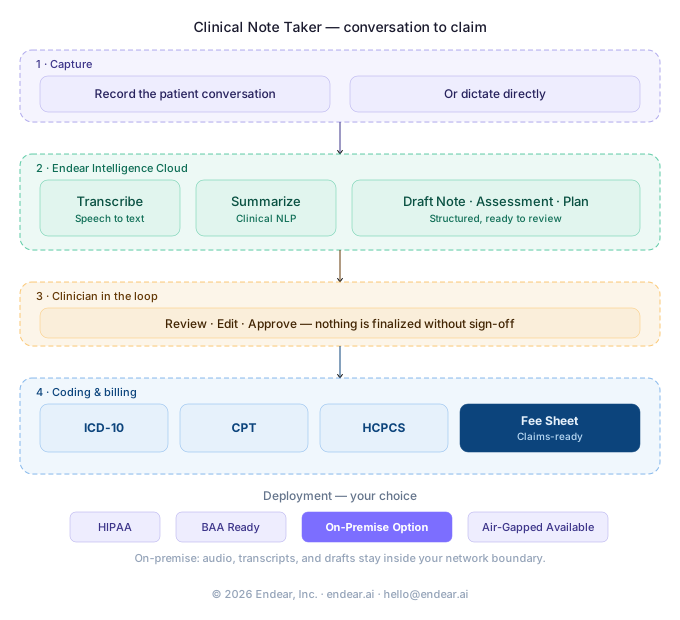
- The Clinical Note Taker records the patient conversation, or a clinician's own dictation, and turns it into a structured draft note, assessment, and plan
- It's built for convenience: minimal setup, minimal clicks, and context that's ready before the clinician even starts talking
- Every draft is reviewed, edited, and approved by the clinician — nothing is finalized automatically
- Approved notes come with suggested billing codes attached, ready to speed up claims
- It's HIPAA compliant and BAA ready
- It can run in Endear's managed cloud, or entirely on your own premises, so the conversation and the data behind it never have to leave your walls
Meet the Clinical Note Taker
The Clinical Note Taker is the tool clinicians actually touch. It's designed around a simple idea: the fewer steps between "start the visit" and "get a usable draft," the more likely a clinician is to actually use it — and the more time it gives back.
Open it, and it's already oriented to the encounter at hand. Start recording, or start talking — the tool doesn't require a special setup ritual before it's useful. That's a deliberate choice. A scribe tool that takes as much effort to operate as the note it's replacing doesn't save anyone any time.
How It Works
The workflow is short by design:
- **Record or dictate.** Capture the natural conversation between clinician and patient, or simply dictate a summary — whichever fits the visit.
- **Let it draft.** The recording is transcribed and summarized into a structured note, assessment, and plan — organized the way clinicians already think, not a raw transcript dump.
- **Review, edit, approve.** The clinician reads the draft, changes what needs changing, and approves it. Only then does it become part of the record.
That review step isn't a formality — it's the point. The Clinical Note Taker's job is to get a clinician most of the way there quickly, and to make the last step — the one requiring actual clinical judgment — the only step left to do by hand.
Built for Convenience, Not Just Capability
A lot of ambient documentation tools are technically impressive and practically annoying — an extra login, a separate app to remember, a workflow that doesn't match how a visit actually happens. The Clinical Note Taker was built around the opposite goal: the technology should disappear into the visit, not compete with it.
That shows up in small ways that add up. Patient and encounter context is ready before the session starts, so nobody re-types who the visit is for. The interface is built for a clinician moving quickly between patients, not for someone with time to learn a complicated tool. And because it can run on the device or workstation a clinician already uses, it doesn't ask anyone to change how their day is structured — just to spend less of it typing.
From Draft to Claim
Once a note is approved, the Clinical Note Taker doesn't stop at documentation. It surfaces suggested ICD-10, CPT, and HCPCS codes based on what was actually documented in the approved note, so the clinician can select the ones that apply and move straight toward billing — instead of a separate coding pass happening hours or days later.
Faster, more consistent coding means claims go out sooner, with fewer errors, and with better alignment between what was documented and what was billed.
Your Data, Your Walls: The On-Premise Option
For a lot of organizations, the conversation itself — not just the resulting note — is the sensitive part. A visit can include things a patient said in confidence that never needed to leave the room, and plenty of organizations are, understandably, unwilling to route that audio through infrastructure they don't control.
That's why Endear Intelligence Cloud, the platform behind the Clinical Note Taker, is available as an **on-premise deployment**. The entire backend — recording ingestion, transcription, summarization, drafting, and coding suggestions — can run inside your own data center or private cloud. Audio, transcripts, and drafts never leave your network boundary. For organizations with strict data-residency requirements, or that simply aren't willing to send patient conversations to a third-party cloud as a matter of policy, this isn't a nice-to-have. It's the deployment model that makes adoption possible at all.
Organizations that don't need that level of isolation can run the same platform in Endear's managed cloud instead — same capability, faster to stand up, fully supported. Either way, it's the same Clinical Note Taker clinicians use day to day.
HIPAA Compliant. BAA Ready.
Wherever it runs, the Clinical Note Taker is built on a platform that's **HIPAA compliant** and **BAA ready** from the start — not adapted after the fact. Organizations can execute a Business Associate Agreement as part of onboarding, with the access controls and audit logging that HIPAA compliance requires already built in.
The Benefit: Time and Presence Back for Clinicians
The specific number of minutes saved varies by specialty and visit length, but the shape of the outcome is consistent: less time typing after a visit ends, less time hunting for the right code, and fewer notes started from a blank page. For a clinician seeing patients all day, that adds up — to time back for patients, for family, or simply for going home on schedule.
That's ultimately the measure that matters. Not whether the technology is impressive, but whether it gives clinicians back the thing documentation has been quietly taking from them.
Conclusion
The Clinical Note Taker is available now, running on Endear Intelligence Cloud, in our managed cloud or entirely on your own premises. It listens, it drafts, and it gets out of the way — so clinicians can spend their time on the part of the job that actually needs them.
If keeping patient conversations inside your own walls is a requirement, not a preference, we'd like to show you what the on-premise deployment looks like.
See Iphea in action.
Policy-controlled agent execution for regulated industries. Early access open now.
Request Early Access